One Community
Highest Good Economics
Sustainable and Highest Good economics® practices are another area that One Community is open source sharing in support of Highest Good of All living and creation. These Highest Good and duplicable resource and sharing-based, for-profit, non-profit, and collaborative-entrepreneurial economics models will be a cornerstone of our self-sufficient and self-replicating teacher/demonstration communities, villages, and cities to be built all over the world.
This page contains the following sections related to how we will be providing a free-shared model to help people develop their own paths to self-sufficiency and financial freedom:
- What is Highest Good Economics
- Why Highest Good Economics
- Ways to contribute
- The Highest Good Economics Open Source Portal (Collaborative resource and information hub)
- Highest Good Economics Details
- Highest Good Economics Rollout Details
- Summary
- FAQ
HIGHEST GOOD ECONOMICS® SEARCH ENGINE
WHAT IS HIGHEST GOOD ECONOMICS®
The One Community definition of Highest Good economics is business that is specifically pursued with the intention and long-term focus to function for The Highest Good of All people and all life on this planet. These businesses are fair, proactive and forward-thinking, ecological, transparent in their function and operation, and they provide value while creating positive impacts individually, locally, and globally.
As an organization we are focused on demonstrating and open source free-sharing duplicable resource-based economy (RBE), for-profit, non-profit, and entrepreneurial economics models that specifically meet all of these criteria.
In so doing, they will function as a foundation of demonstrating that living and creating for The Highest Good of All can function proactively in existing competitive markets, free people from debt, and provide developing teacher/demonstration communities, villages, and cities ongoing capital for upkeep and further expansion.
Click to Enlarge
WHY HIGHEST GOOD ECONOMICS®
 Highest Good approaches to doing business have the potential to change the world positively and permanently for everyone. By developing duplicable RBE, for-profit, non-profit, and entrepreneurial economics models that are successful while specifically focusing on what is for The Highest Good of All , we can provide people with options that serve their individual needs while also providing benefits to everyone else too.
Doing this as part of our open source and free-shared model for global transformation will provide all the details people need to develop additional iterations and evolutions of these kinds of businesses and, in the most positive and proactive expression of this process, lead to a new paradigm of how people look at the idea of building businesses and making money.
WAYS TO CONTRIBUTE TO EVOLVING THIS SUSTAINABILITY COMPONENT WITH US
SUGGESTIONS | CONSULTING | MEMBERSHIP | OTHER OPTIONS
CLICK THESE ICONS TO JOIN US THROUGH SOCIAL MEDIA


ECONOMIC OPEN SOURCE PORTAL
 Our Pioneer team is specifically requested to be fairly financially free to help assure the success and integrity of One Community to build open source blueprints for teacher/demonstration communities, villages, and cities like One Community. Part of this is economics models that use self-sufficient infrastructure combined with open source economics practices to help spread the model further while also allowing people to get out of debt, save for college, retire, etc. The areas we are open sourcing to support this include:




HIGHEST GOOD ECONOMICS® DETAILS
 The entire marketing and sharing engine we are creating is also being developed specifically to support and refer interested people to other self-sufficient teacher/demonstration communities, villages, and cities using and helping us grow and evolve the whole open source and free-sharing process more and more for The Highest Good of All. Additionally, once established and demonstrated as successful, the One Community Highest Good economics model will also function as a duplicable investment model for people who would like to fund teacher/demonstration hubs as a path to:
- Investor profit
- Alleviation of debt for members
- The One Community lifestyle as an alternative to a traditional job
HIGHEST GOOD ECONOMICS ROLLOUT DETAILS
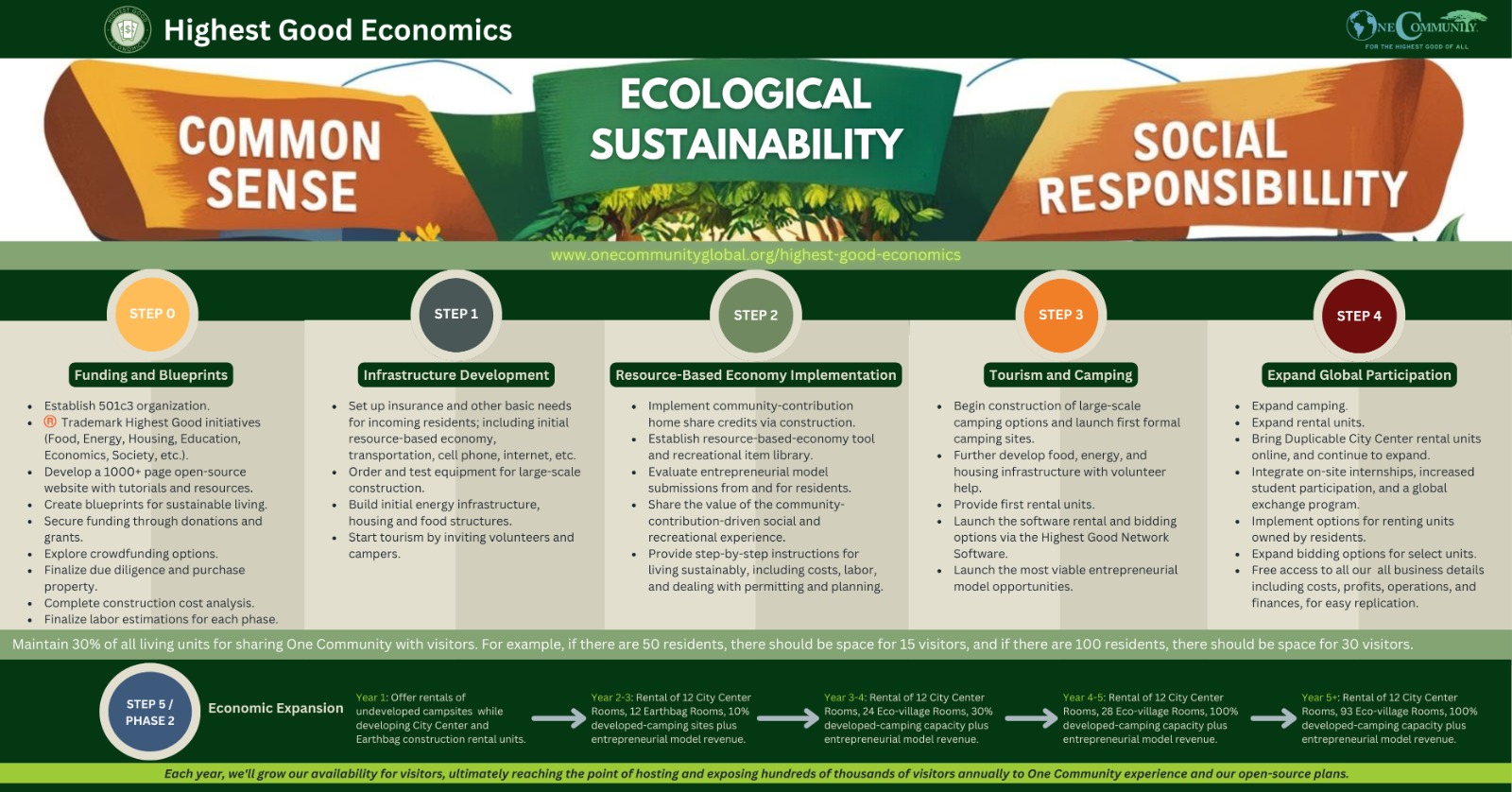
As part of planning Highest Good economics, we have estimated how long it will take to implement all the various components. The full Highest Good economics rollout is estimated at about 36 months of work. Timing for each step is shown in relative months, where Month 1 is the first month on the property, so the plan stays accurate no matter when we land. Every estimate comes from a published One Community source or an internal estimate, and each one is listed on the Sources tab of the spreadsheet. Click these links for details on each part of the rollout plan:
- Step 0: Funding and Blueprints
- Step 1: Initial Survey Team: 3-10 People
- Step 2: Landing Party: 10-20 People
- Step 3: Pioneer Team: 20-50 People
- Step 4: Continued Construction: 50-100 People
- Step 5/Phase 2: World Invited: 100-400 People
The donut below shows how the full build time splits across the steps. Click it to open the most current version of the spreadsheet, which includes every source behind these numbers.
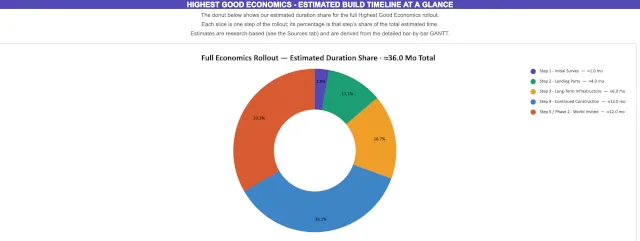
Highest Good Economics Rollout Estimated Duration Share, click for the most current spreadsheet that includes sources
All estimates and their sources are listed on the Sources tab of the same spreadsheet.
The chart below shows the entire plan in one view. Each colored bar is one action item and its width is the estimated duration. The longest runs are all in Step 4: the large-scale camping build-out, the on-site volunteer scale-up, and the infrastructure work that volunteer labor makes possible. Together they explain why that step runs longer than any other.
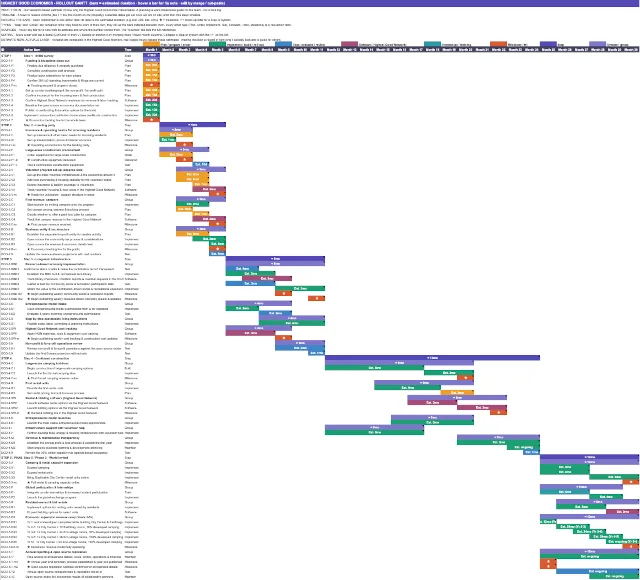
Full Highest Good Economics Rollout GANTT, click for the most current spreadsheet that includes sources
The labels on the full chart are small on purpose, because the point of this view is the shape and scale of the whole build rather than any single bar. The per-step charts further down carry the readable detail.
STEP 0: FUNDING AND BLUEPRINTS
Before anyone is on the property, the economics foundation has to exist. This step covers establishing the 501(c)3 organization (done), trademarking the Highest Good initiatives and our logos (done), developing the open source website and its tutorials (ongoing), creating the blueprints for sustainable living (ongoing), securing funding through donations and grants, exploring crowdfunding options, finalizing due diligence and the property purchase, completing the construction cost analysis, and finalizing labor estimations for each phase.
Most of this work is already done or well underway, which is why it does not appear as bars on the timeline. The tracker starts counting at Month 1, the first month on the property, and the few Step 0 items that land at move-in are carried into Step 1 below.
STEP 1: INITIAL SURVEY TEAM: 3-10 PEOPLE
Step 1 is short. It is about paperwork and tracking rather than spending. The whole step is estimated at about one month, and the action items overlap almost entirely, since none of them waits on another to finish.
The one thing worth noticing here is that community contribution home share credits start counting from day one. Every construction hour logged in the Highest Good Network counts toward them, so there is no separate launch later, only the audit and the public version of the record that comes in Step 3.
The action items for this stage of the economics rollout are as follows:
- Finalize due diligence and property purchase
- Finalize Phase one construction cost analysis
- Finalize labor estimations for each phase
- Confirm 501(c)3 standing, trademarks, and filings are current
- Set up on-site bookkeeping and the non-profit / for-profit split
- Confirm insurance for the incoming team and first construction
- Confirm Highest Good Network readiness for revenue and labor tracking
- Baseline the open source economics documentation set
- Publish crowdfunding and donation options for the build
- Implement community contribution home share credits via construction
3-10 PEOPLE ECONOMICS TIMELINE SPECIFICS
Click the image below to open the full detail for this step. There is not much to expand here, but the same click approach works for every chart on this page.

Step 1 Rollout Timeline, click for the most current spreadsheet that includes sources
The donut below shows the same step as a share of time rather than as a timeline.
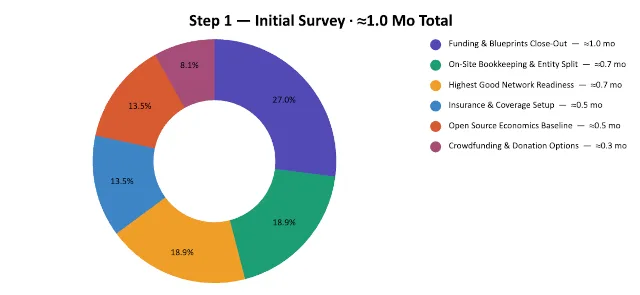
Step 1 Estimated Duration Share, click for the most current spreadsheet
STEP 2: LANDING PARTY: 10-20 PEOPLE
Step 2 is estimated at about four months and it is where the first money comes in the door. These first 10 to 20 people are all core team pioneers. No on-site volunteers arrive yet, so everything here is either revenue coming in from campers or groundwork being laid for much later.
Part of that groundwork is the volunteer model itself. We now finalize what it will cost to house, feed, and insure people who are not pioneers, so the numbers are understood long before anyone arrives. The other thread running through this step is the legal one: a separate for-profit entity has to exist for any activity that cannot operate under the non-profit, and the community tax process gets open sourced alongside it.
The action items for this stage of the economics rollout are as follows:
- Set up insurance and other basic needs for incoming residents
- Set up transportation, phone, and internet accounts
- Order equipment for large-scale construction, then test and commission it on arrival
- Define the on-site volunteer support model and the economics around it
- Investigate insurance and liability coverage options for on-site volunteers
- Start tourism by inviting campers onto the property
- Set camper pricing, waivers, and booking process
- Decide whether to offer a paid food plan for campers
- Track first camper revenue in the Highest Good Network
- Establish the separate for-profit entity for taxable activity
- Open source the community tax process and considerations
- Open source the revenue and economic details feed
- Update the revenue-stream projections with real numbers
10-20 PEOPLE ECONOMICS TIMELINE SPECIFICS
Click the image below and follow the camper revenue group in the middle of the step. It is the first money coming in the door, and it runs alongside the construction procurement that the rest of the build depends on.
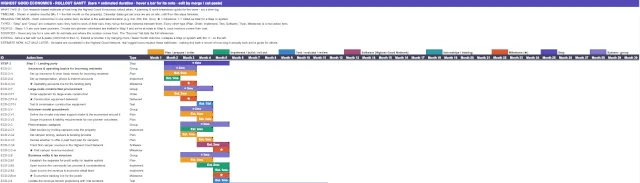
Step 2 Rollout Timeline, click for the most current spreadsheet that includes sources
The donut below shows how the four months divide across the systems in this step.
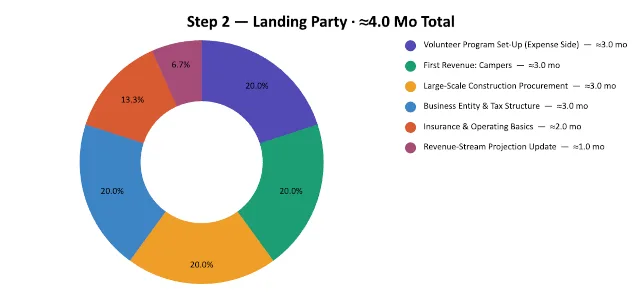
Step 2 Estimated Duration Share, click for the most current spreadsheet
STEP 3: PIONEER TEAM: 20-50 PEOPLE
Step 3 is estimated at about six months and it is where the resource-based economy stops being a concept and starts being something you can watch working. The tool and recreational item library are established, home share credits get audited and made transparent, and the entrepreneurial model opens for submissions from residents.
The thing that shapes this step is publishing. Three separate weekly public reports begin here, and each one needs about three months of data collection behind it before anything goes out. That is why the gathering and testing work sits early in the step and the publishing milestones land at the end of it. Nothing is published until the numbers behind it have been checked.
The 20 to 50 people here are still almost entirely core team pioneers. We do expect to bring on a small number of non-pioneer volunteers in this step to test how that works in practice, because it is genuinely different. A pioneer earns home share credits for the hours they contribute, so their work flows back to them through the community model.
A non-pioneer volunteer does not earn credits, is insured differently, and sits outside the decision-making process. This step is where we confirm what that actually costs before doing it at scale. It is also important we be precise about the word volunteer here, because we mean two different things by it.
Our off-site volunteer team will be running 200 to 300 people consistently and is how most of this website got built. What is new in this step is a small group of on-site volunteers chosen to live with us on the property.
There is a second reason this step matters. Our social and recreational spaces cost us almost nothing to run, and campers, on-site volunteers, and anyone else visiting all have access to the same events, tracked in the Highest Good Network. Once both campers and initial volunteers are on the property, we can put a real number to the value of this. Someone might pay a nightly camping fee and take classes and experiences worth several times what they paid. That is worth publishing, and this step is where we can first measure it.
The action items for this stage of the economics rollout are as follows:
- Audit home share credits and make the contribution record transparent
- Establish the resource-based economy tool and recreational item library
- Track library checkouts, condition reports, and member requests in the Highest Good Network
- Gather and test the community social and recreation participation data
- Share the value of the contribution-driven social and recreational experience
- Begin publishing weekly community social and recreation reports
- Begin publishing weekly resource-based economy results and updates
- First publication of the social and recreation value delivered to visitors
- Open entrepreneurial model submissions from and for residents
- Evaluate and score incoming entrepreneurial submissions
- Publish step-by-step sustainable living instructions covering costs, labor, permitting, and planning
- Apply Highest Good Network materials, tools, and equipment cost tracking
- Begin publishing weekly cost tracking and construction cost updates
- Review non-profit and for-profit operations against the open source model
- Set up the initial volunteer infrastructure and the economics around it
- Add food purchasing and housing capacity for the initial volunteer intake
- Extend insurance and liability coverage to initial volunteers
- Trial a small group of initial on-site volunteers
- Track initial volunteer housing and food costs in the Highest Good Network
- Update the first-5-years projection with actuals
20-50 PEOPLE ECONOMICS TIMELINE SPECIFICS
Click the image below and look for the star markers clustered near the end of the step. Most are the moment a new weekly public report goes live, and tracing back from each one shows you the months of data collection that had to happen first.
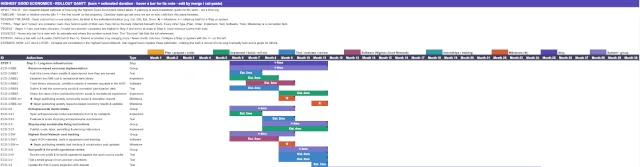
Step 3 Rollout Timeline, click for the most current spreadsheet that includes sources
The donut chart below shows the same step by share of time, which makes it obvious how much the resource-based economy work dominates everything else here.
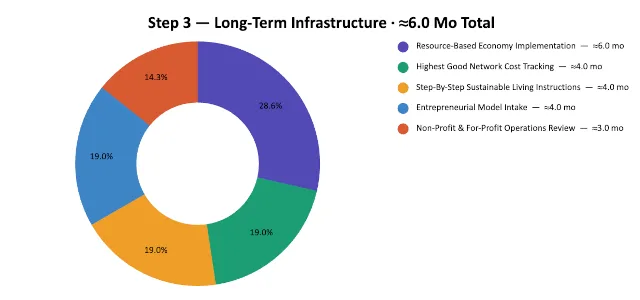
Step 3 Estimated Duration Share, click for the most current spreadsheet
STEP 4: CONTINUED CONSTRUCTION: 50-100 PEOPLE
Step 4 is the longest step at about 13 months, and one thing drives nearly all of it. Economics revenue at scale is gated by built capacity, not by paperwork. Formal camping sites and rental units have to physically exist before they can earn anything, and building them takes the better part of a year.
This is the step where the eco-tourism business becomes real and where the on-site volunteer model really starts ramping up. Developed campsites open, the first rental units come online, rental and bidding move into software rather than being handled by hand, and the entrepreneurial submissions that cleared review in Step 3 get launched.
The on-site volunteer ramp up belongs here for two reasons. There are now around 50 pioneers on the property, which is an established enough team to manage people who are not core team. And revenue is finally being generated, which is what covers the cost of those people. Campers are a revenue source. On-site volunteers are not. We house them, feed them, and insure them, so they sit on the expense side of the model even though they contribute enormous value in labor.
Most properties we are looking at already have existing infrastructure, and that is what houses the Pioneer team while the permanent homes go up. As people move into permanent housing, the temporary housing they leave behind becomes the on-site volunteer housing, already set up and proven to meet our needs.
The action items for this stage of the economics rollout are as follows:
- Begin construction of large-scale camping options
- Launch the first formal camping sites
- Begin large-scale on-site volunteer onboarding
- Scale food purchasing, housing, and insurance capacity for the full intake
- Track on-site volunteer housing and food costs at scale in the Highest Good Network
- Determine the sustainable on-site volunteer to resident ratio
- Further develop food, energy, and housing infrastructure with volunteer help
- Provide the first rental units
- Set rental pricing, terms, and turnover process
- Launch software rental options via the Highest Good Network
- Launch bidding options via the Highest Good Network
- Launch the most viable entrepreneurial model opportunities
- Establish the annual profit and loss process and publish the first year of revenue-stream details
- Start ongoing business learning and development archiving
- Review the 30% visitor-capacity rule against actual occupancy
One rule sits across all of this: 30% of all living units stay available for sharing One Community with visitors. If there are 50 residents there should be space for 15 visitors, and if there are 100 residents there should be space for 30. This will be in the form of permanent housing, not the temporary housing used for on-site volunteers.
The 30% is 30% of permanent housing, which is what we build. On-site volunteers are not housed there. Most properties we are looking at already have existing infrastructure, and that is what houses the Pioneer team while the permanent homes go up. As people move into permanent housing, the temporary housing they leave behind becomes the on-site volunteer housing, already set up and proven to meet our needs.
50-100 PEOPLE ECONOMICS TIMELINE SPECIFICS
Click the image below and follow the long bar running across the first half of the step. That is the camping build-out, and watching where it ends tells you exactly when the first formal camping revenue can start.
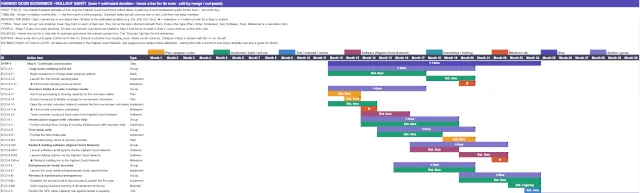
Step 4 Rollout Timeline, click for the most current spreadsheet that includes sources
The donut below breaks the same step down by system, with the camping build-out taking the largest share.
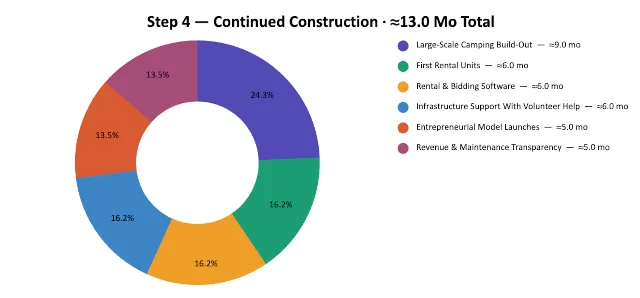
Step 4 Estimated Duration Share, click for the most current spreadsheet
STEP 5/PHASE 2: WORLD INVITED: 100-400 PEOPLE
Step 5 is ongoing rather than a fixed build, so the roughly 12 months shown here represents continued expansion rather than a hard finish date. Camping and rental capacity keep growing, Duplicable City Center rental units come online, residents get the option to rent out units they own, and the global exchange program opens. The volunteer ratio established in Step 4 becomes the rule for growth here: as the resident team grows toward 400, the on-site volunteer count grows with it at the proven ratio, with food, housing, and insurance capacity sized to match.
Underneath the expansion is a revenue ramp that runs across years rather than months. Year one is rentals of undeveloped campsites while the City Center and Earthbag units are still being built. By years two and three, that becomes 12 City Center rooms, 12 Earthbag rooms, and 10% developed camping. By year five and beyond it is 12 City Center rooms, 93 Eco-village rooms, and 100% developed camping capacity, plus entrepreneurial model revenue throughout. Each year we grow our availability for visitors, ultimately reaching the point of hosting hundreds of thousands of visitors annually.
This is also where the reporting matures. The annual year-end summary becomes a repeatable product rather than a one-off effort, and two years in we confirm that everything on the economics side has genuinely been open sourced, with tutorials complete enough for someone else to replicate from. By this point the estimates on this page start being replaced by real logged hours from our own build, which is the whole reason the tracker is built this way.
The action items for this stage of the economics rollout are as follows:
- Expand camping and expand rental units
- Bring Duplicable City Center rental units online
- Integrate on-site internships and increased student participation
- Launch the global exchange program
- Implement options for renting units owned by residents
- Expand bidding options for select units
- Run the economic expansion revenue ramp across years one through five and beyond
- Provide free access to all business details, costs, profits, operations, and finances
- Establish the annual year-end summary process and publish year one
- Confirm open source replication tutorials for all business details
- Run an annual open source completeness and replication check-in
- Apply the on-site volunteer to resident ratio as the community scales
- Open source share the economics results of collaborative partners
100-400 PEOPLE ECONOMICS TIMELINE SPECIFICS
Click the image below to see the full detail, then open the spreadsheet from there for the live version. This is the step that changes most as we go, because the year-by-year revenue bars get replaced with what actually happened.
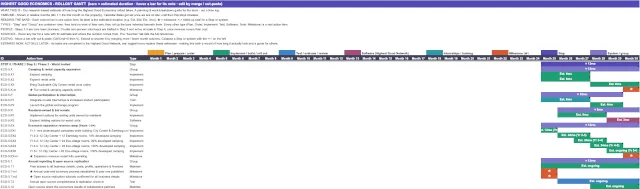
Step 5 Rollout Timeline, click for the most current spreadsheet that includes sources
The donut below shows how the ongoing work in this step divides up.
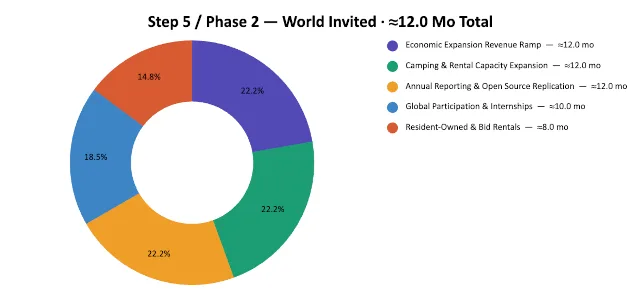
Step 5 Estimated Duration Share, click for the most current spreadsheet
Everything on this page is an estimate today and a record later. As tasks are completed in the Highest Good Network software, real logged hours will replace these estimates, which makes this both a record of how long the build actually took and an estimation-vs-reality guide for anyone replicating it.
SUMMARY
One Community is a structure for creating self-sufficient and self-propagating teacher/demonstration communities, villages, and cities and we think non-profit and for-profit business development is an important component of this. We’re bringing a team together intentionally financially free to build this model so it can spread as fast as possible. One key to this is demonstrating it as a way to financial freedom for others too. We will do this through open source and free-sharing Highest Good approaches to RBE, for-profit, non-profit, and entrepreneurial economics models.
FREQUENTLY ANSWERED QUESTIONS
Q: Is anyone (directors, consultants, etc.) paid as part of One Community?
No, we are a 100% unpaid volunteer organization.
Q: How would individuals who want to make money as part of One Community do so?
Please see our entrepreneurial model page.
Q: Are you basing these concepts on an existing model? In other words, how confident are you they will work?
These concepts are based on the foundations of intelligent business in almost any industry: providing value, low cost to profit ratio, and a quality marketing engine. The successful (and growing) model to compare what we are creating with would be the affordable tourism industry. Affordable tourism continues to gain market share and sustainability as an industry, and interest in it continues to grow.
Visiting a property like One Community’s, an environment like One Community’s, and hands-on experience with all of One Community’s open source blueprints and creations all add to our desirability and marketability.
Further add to this that the entire “staff” of One Community are non-profit volunteer residents not doing a “job,” but rather operating the Highest Good society model that is the core of One Community, makes it a fun place to be and visit, and an exciting and world changing organization to maintain.
Combining all these things produces a place people want to visit, that will offer much more interesting and fun things to do, at a lower price, with a higher profit margin, staffed by people who are (instead of “workers”) equal and full shareholders in the experience. On top of this, we are changing the world for the better and the more fun and beautiful residents make One Community, the more they individually benefit, the more visitors benefit, and the more it benefits One Community’s global transformation goals.
For these reasons, we are very confident in the financial viability of One Community.
Q: What about duplicability, how will this be duplicable for others?
The marketing engine of One Community is growing to specifically support and coordinate with other teacher/demonstration communities, villages, and cities too. When other teacher/demonstration hubs contribute to the global open source archive, we will help them promote their work through our engine. We will operate this like a franchise where inclusion is based on open source contributions to positive and permanent global transformation. This means future models will have a significantly easier time implementing this same model. We are also open source free-sharing the complete for-profit, non-profit, and entrepreneurial models and details of One Community so others will be able to duplicate them without association with One Community.
Q: Why do you have a for-profit component, why not be 100% non-profit?
There are two primary reasons for this:
First, in essence One Community is establishing itself to place maximum profits into our non-profit and global goals. However, there are elements of One Community that will not legally fall under the umbrella of a non-profit and these areas will need to be classified and taxed as for-profit ventures operated under a separate legal entity. We also see it as a positive thing for both One Community and Visitors so long as we offer enough value that people feel good about the investment in the for-profit elements of One Community. In this way we hope to demonstrate and spread Highest Good economics as part of our model too.
Second is our goal to demonstrate and open source share a model that is A) sustainable and B) can meet the needs of as many people as possible. In the case of the model being sustainable, we do not consider any model that operates 100% on donations as a sustainable and duplicable solution because donated resources are limited. Revenue is also necessary to purchase everything that cannot be produced effectively internally like machinery, appliances, technology, clothing, some food items, vehicles, etc. These items will differ for different people in different locations and an effective revenue stream addresses this.
In the case of meeting the needs of as many people as possible, One Community is also taking into account those who have debt, those seeking only to invest, and the reality that there will be many who will try a model like this and then change their mind and want to leave and/or do something else. The for-profit element of One Community is purposed to provide duplicable revenue streams that help all three of these groups while also helping share and spread teacher/demonstration communities, villages, and cities by demonstrating them as a progressive and profitable opportunity.
Q: If you are a team of people without debt, how do you intend to teach people with debt how to become free of debt?
Our goal is to clearly define as many of the variables as possible for creating a financially viable teacher/demonstration hub with a diversity of options for implementation to suit different demographics and budgets. The more One Community grows and expands, the more open source blueprints, tools, tutorials, and resources we will provide for others to duplicate our efforts. This is why we are focused on people joining the Pioneer Team that are financially stable, so we can focus 100% of our energy on open source creation for those that aren’t in such a fortunate position. This is also one of the reasons why we won’t move onto the property with any debt as an organization.
Q: If you are a non-profit organization, how do you intend to operate for-profit businesses too?
Any activities of One Community deemed by tax code and federal law to not be operable under our 501(c)3 status will be operated under a separate for-profit corporate entity.
Q: Will one community ever pay any of its members?
One Community’s #1 financial priority is expansion and our global goals. If we are accomplishing expansion and these goals successfully, and a 100% consensus of the membership agrees that distribution of funds is warranted and will not in any way compromise these goals, then distributions can be made.